AyearofkillingCall (714) 851-4559

Diagnosis First, Huntington Beach

We Test the Door Before We Price Anything

Technician hand testing the balance of a garage door in Huntington Beach, CA

Most doors we are called to look at do not need replacing. The only way to know is to pull the release cord, lift the door by hand and work through the rest of the checks in order.

  • Balance tested by hand
  • Findings written down
  • Licensed and insured

Diagnosis Notes

How the repair or replace call actually gets made, at the door.

Garage Door Repair or Replacement in Huntington Beach: How the Call Actually Gets Made

Garage Door Repair or Replacement in Huntington Beach: How the Call Actually Gets Made

Somebody stands in your driveway for four minutes, looks at your garage door, and tells you it needs replacing. No tools came out of the van. Nothing was measured. What happened in those four minutes was not a diagnosis, and this post is about what one actually looks like.

Start By Taking the Opener Out of the Equation

The first thing that should happen on any garage door call is that the opener gets disconnected. Door closed, red release cord pulled, motor now irrelevant.

Then the door gets lifted by hand and stopped at three heights: about knee, about waist, about shoulder. At each one it should stay put when you let go, and getting it there should take roughly ten pounds of effort. That is a balanced door.

If it sinks toward the floor, the springs have lost tension or were never sized correctly for the weight. If it climbs on its own, they are overwound. If lifting it takes both arms and a grunt, one spring has broken and you may genuinely not have noticed, because a good opener will keep hauling a door up on one spring for weeks before it fails.

This one test explains most of the complaints that come in. Door reverses halfway. Door bangs on the way down. Opener runs but the door barely moves. Opener died after four years. All four of those are commonly reported as opener problems and all four are frequently balance problems, because an opener fighting an unbalanced door is grinding its gears against a load it was never designed to lift.

The reason it comes first is not just that it is informative. It is that it is impossible to fake. Everything after this point is interpretation. The hand test is a fact.

Springs: Look for a Gap, Then Get the Caliper Out

Torsion springs sit on a shaft above the opening. Extension springs run along the horizontal tracks either side. Either way, the first check is a visual sweep of the full length looking for a gap in the coil, because a broken spring shows as a clean two inch space and there is no ambiguity about it.

If they are intact, the numbers matter. Wire diameter measured across twenty coils with a caliper, overall length, inside diameter. Those three figures give you the spring’s rated cycle life and, more usefully, tell you whether the spring on your shaft was ever the correct spring for your door.

A standard spring is rated at 10,000 cycles. One cycle is up and down once. A family using the garage as its front door averages four to six cycles a day, which puts a standard spring somewhere around the seven year mark. That is a consumable wearing out on schedule.

Houses that go through a spring every two years are almost never unlucky. They are running undersized wire, usually because somebody replaced a broken spring with whatever was on the van rather than what the door weighs. Nobody finds that unless they measure, which is why measuring is on the list.

Cables, and Why the Bottom Eighteen Inches Is All That Matters

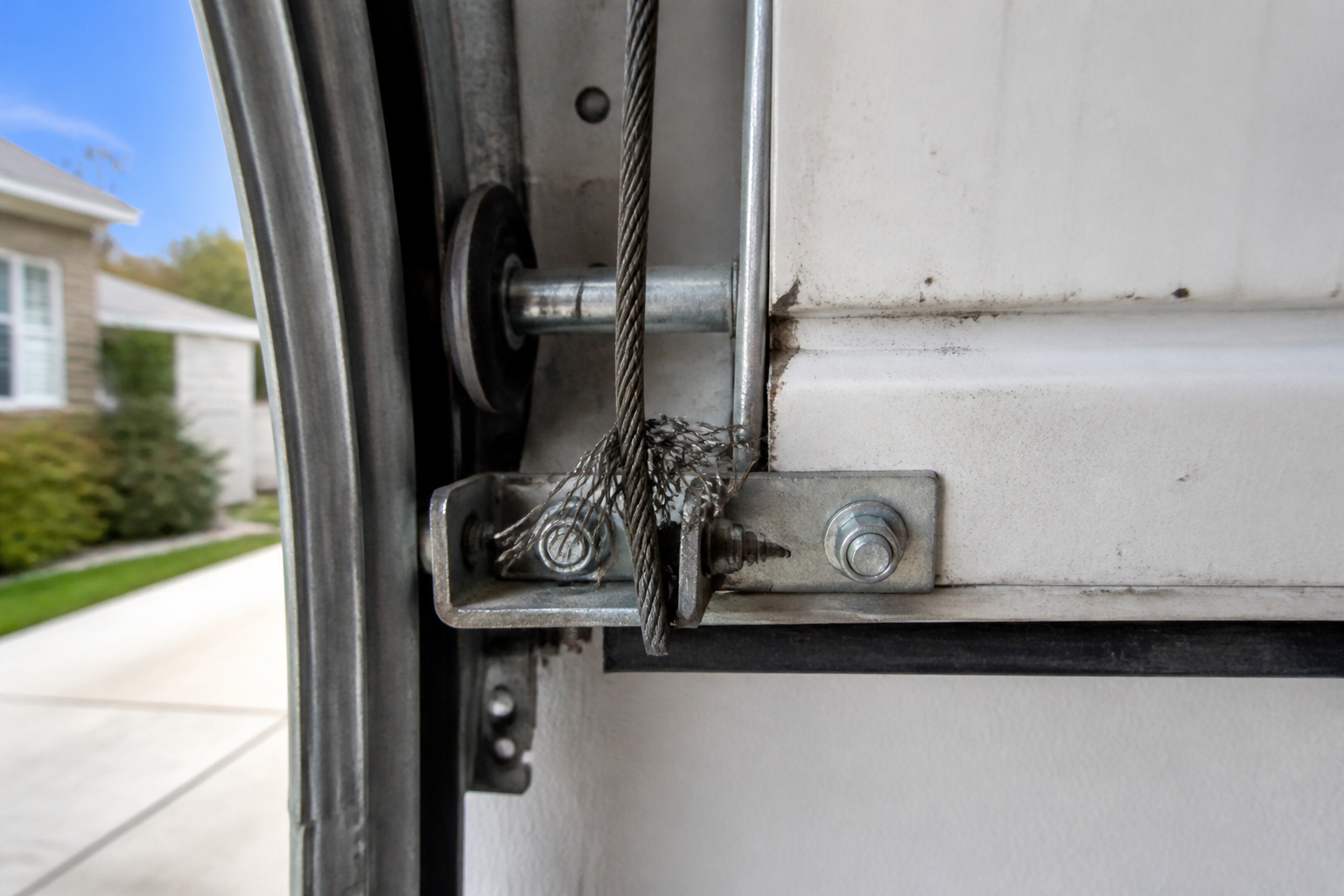
Two stranded steel cables lift the door, running from a bracket at each bottom corner up to a grooved drum on the shaft. The bottom eighteen inches is where they fail.

We are looking for broken strands standing proud of the others, for a flattened section, and for rust weeping out from between the strands. That last one is the coastal tell, and it is the reason this check gets done slowly in Huntington Harbour rather than at a glance.

Salt air corrodes stranded cable from the inside outward. The core goes first while the outer surface still looks entirely serviceable, so a cable can present as fine and be days from parting. When one does part, that corner stops rising, the door goes up crooked, jams in the track, and what would have been a cable set becomes a bent track and a twisted section within about three more attempts.

Track, Roller Stems and Bearings

Vertical track gets sighted down its length for bowing. Horizontal track gets checked for sag and for the hanger pulling away from the ceiling joist.

Then the rollers, out one at a time. A roller fails in two places. The stem wears oval, which lets the wheel sit at an angle so it scrapes instead of rolls. Or the bearing packs with grit and simply stops turning, at which point the roller is being dragged along the track like a skid.

The second failure is common a few blocks from the sand, for the obvious reason. Fine grit gets into everything on this side of Pacific Coast Highway, and an unsealed steel bearing collects it. The test is simple: spin each roller under a thumb. If it does not turn freely, it is not doing its job, and it is slowly chewing the track it sits in.

The Section Check Is the One That Decides Everything

Now the part that determines whether this is a repair or a replacement, which is a question about the door itself rather than the parts bolted to it.

On a steel sectional, the bottom section is the one that matters. Corrosion starts on the inside face, where condensation collects and, near the water, where salt gets carried in on the marine layer. By the time rust shows through on the outside skin, the seam behind it is often already soft.

So it gets pressed, firmly, along its length. Steel that gives under thumb pressure at the bottom seam is not cosmetic damage. The bottom bracket bolts to that steel, and the bottom bracket is what the lift cable pulls on. There has to be something solid there or the whole load has nowhere to go.

On a wood door the equivalent finding is delamination along the bottom rail, where the plies have separated and swollen from years of sitting in a wet driveway.

Then every hinge point, top to bottom. What we are looking for is elongated screw holes and torn steel around the fasteners. Each repair at a given hinge tends to move the fastener half an inch to find fresh metal, and there is a limit to how many times that works. Once the steel around the holes has torn out, that section has nothing left to grip, and you cannot buy one replacement section for a door that went out of production a decade ago.

Opener: Two Tests, Not One

Force and reversal get tested separately, because they are separate systems and both are required.

The photo eyes first. Something goes through the beam while the door is closing, and the door must stop and reverse. Then the force setting: a solid object on the floor under the door, and the door must reverse on contact with it.

UL 325 has required both since 1993. A great many doors pass the photo eye test and quietly fail the contact test, usually because someone turned the force up to compensate for a door that is heavy, which brings us back to the balance test at the start.

If you are buying a new opener in California, it needs battery backup. SB-969 has required that on any opener sold or installed since July 2019, so the door still opens when the power goes out. Existing openers can stay as they are. Replacements cannot.

So: Repair or Replace

With all six results on the table, the call comes down to two questions.

Are the sections sound. Can the hardware still be sourced.

Sound sections and worn hardware is a repair, almost regardless of age. Springs, cables, rollers, hinges and bearings on a typical two car door add up to a fraction of what a new door and installation cost. Hardware is the cheap part. That is not a marketing position, it is arithmetic, and it is the reason a genuine assessment usually lands on repair while a sales visit usually does not.

A rusted through or delaminated bottom section is a genuine replacement. So are torn out hinge points on a discontinued door. So is one piece tilt up geometry with jamb hardware nobody makes any more, which turns up regularly on the older garages around town and is the one case where the honest answer really is that the door has run out of road.

Two Sentences Worth Being Suspicious Of

The first is “your door is old”. It is not a diagnosis. It is a substitute for one, and it tends to appear precisely when no balance test has been done. A perfectly reasonable reply is to ask which test produced that conclusion.

The second is a broken spring turning into a quote for a new door. This is the single most common upsell in the trade. A spring reaching its cycle count tells you about the spring. It carries no information whatsoever about the condition of the sections above it. If the two got connected somewhere between the driveway and the paperwork, ask how.

You can run the first test yourself this evening and it costs nothing. Close the door, pull the release cord, lift to waist height, let go. Whatever the door does next is the most honest thing anybody is going to tell you about it.

If it does not hold, call (714) 851-4559 and we will come and do the other five.

Read the full article

From Sunset Beach Down to Beach Boulevard

We run the full diagnostic sequence anywhere in Huntington Beach and the towns either side of it.

Call (714) 851-4559. If a spring is visibly broken, leave the door down and do not try the opener.

  • Huntington Beach, CA (92646, 92647, 92648, 92649)
  • Huntington Harbour, CA
  • Sunset Beach, CA
  • Fountain Valley, CA
  • Westminster, CA
  • Seal Beach, CA
  1. The hand test comes firstRelease the opener, raise the door to waist height and let go. A balanced door holds. One that drops or climbs has a spring problem, and no amount of opener adjustment will hide it.
  2. Hardware is the cheap halfSprings, rollers, cables and hinges are a small fraction of what a door costs. Sound sections with tired hardware is a repair almost every time, whatever the age on the label.
  3. Age is not a diagnosisIf someone tells you the door is old and stops there, they have not tested anything. Old is a number. Rusted through, delaminated or unsourceable is a reason.

Ayearofkilling diagnoses garage doors in Huntington Beach. Every visit starts the same way, with the opener disconnected and the door lifted by hand, because that one test explains more complaints than the rest of the inspection put together.

A garage door is two separate things bolted together. There are the sections, which are the door itself, and there is the hardware, which is springs, cables, drums, rollers, hinges and track. They wear out on completely different timescales, and confusing the two is how people end up buying a door they did not need.

So the finding we reach is not a mood or a guess. It comes out of a fixed sequence of tests, run in the same order on every visit, and we tell you what each one showed even when the answer is that nothing is wrong with that part.

Six Tests, Run in the Same Order Every Time

The sequence below is what a diagnostic visit actually consists of. It takes about forty minutes on a two car door.

011. Disconnect and Hand Test the Balance
Opener released, door lifted manually and stopped at three heights. It should stay where it is put and move with two fingers of effort. Sagging, climbing or a heavy dead weight all point at spring tension before anything else gets blamed.
022. Springs: Gaps, Wire Size and Drums
Torsion springs get sighted along their length for a gap, which means a break. Then wire diameter and length get measured, because a door running on undersized springs will keep eating them until somebody works out why.
033. Cables at the Bottom Bracket
The lowest few inches of each lift cable is where fraying starts, and near the water it starts early. Broken strands, flattening or rust bleeding between the strands means the cable set is on its way out.
044. Track, Roller Stems and Bearings
The vertical track gets sighted for bowing and the horizontal for sag. Rollers come out one at a time to check the stem for wear and the bearing for grit. A roller that will not spin under a thumb is dragging the door.
055. Bottom Section, Hinges and Struts
This is the check that decides repair against replacement. Steel gets pressed at the bottom seam for rust through, and the hinge points get looked at for elongated holes and torn steel around the fasteners.
066. Opener Force and Reversal, Separately
Force setting and safety reversal are two different tests and both are required. Photo eyes get blocked mid travel, then a solid object goes under the door. UL 325 wants both to work, and a door with a bad balance will pass neither honestly.

Hardware Prices, and What a New Door Really Runs

Published so you can see the gap for yourself. The point of the list is that the top line and the bottom line are nowhere near each other.

Diagnostic Visit$0 with a repair, $75 aloneHardware Repairs$180 to $620Full Door Replacement$1,250 to $3,400
  • All six tests, findings written down
  • No obligation to book work
Book the visit
  • Springs, cables, rollers, hinges
  • Re-balanced and re-tested after
Book it
  • Only when a section has failed
  • Old door and hardware hauled away
Ask if you need one

Honest Answers About Repairing or Replacing

My door is twenty five years old. Should I just replace it?
Not on the age alone. We have condemned eight year old doors with rotten bottom sections and repaired thirty year old ones that were structurally fine. What matters is whether the sections are sound and whether the hardware is still available. Age correlates with those things but it does not decide them.
What actually makes a door a replacement?
Three findings, mainly. A bottom section rusted through or delaminating, so there is nothing solid to bolt hardware to. Hinge points torn out where repeated repairs have already been attempted. Or a one piece tilt up with jamb hardware nobody still makes, where the pivot arms cannot be replaced at any price.
A company quoted me a new door for a broken spring. Is that normal?
It is common, which is not the same thing. A spring call arriving as a door sale is the single most frequent upsell in this trade. A broken spring says nothing whatsoever about the condition of the sections. Ask them which test told them the door itself was finished.
Can I do the balance test myself?
Yes, and you should, because it costs nothing. Close the door, pull the red release cord, then lift by hand to about waist height and let go. If it holds still, the springs are roughly right. If it slams down or shoots up, ring somebody and stop using the opener in the meantime.
Does living near the water change the answer?
It moves the timeline. Salt air corrodes cables from inside the strand and eats the bottom seam of a steel section from the inside face, where you cannot see it. In Huntington Harbour we find bottom sections failing years earlier than the same door would inland, so we press that seam properly rather than glancing at it.
Do I need battery backup on a new opener?
In California, yes, on any opener sold or installed since July 2019. SB-969 requires a battery backup so the door still opens in a power cut. If your existing opener predates that it can stay, but the moment you replace the unit the new one has to comply.

Ask for the Test Results, Not the Sales Pitch

Ring us and we will come out, run the six tests and tell you what each one showed. If the answer is that your door needs two rollers and a spring, that is what we will say, and we would rather do that job than sell you a door you did not need. If a section really has gone, you will get the reason and the photograph, not just the word old.

Call (714) 851-4559