Garage Door Cable Repair, and Why a Broken Cable Is Not a Broken Spring
On
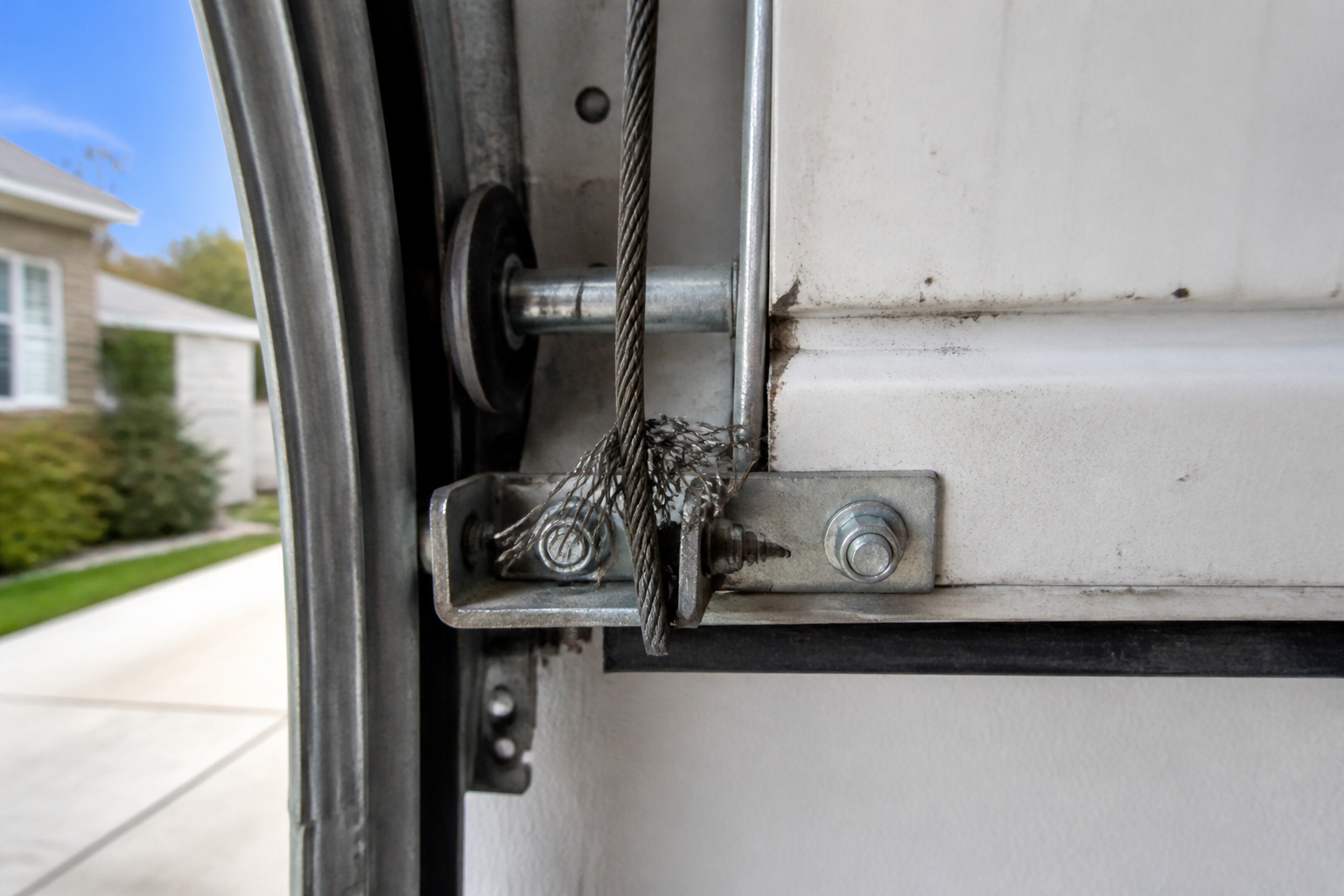
There are two steel cables on a residential garage door, one on each side, running from a bracket at the bottom corner of the door up to a grooved drum at the end of the torsion shaft. They are perhaps an eighth of an inch thick. They are the only thing connecting the spring system to the door itself, and almost nobody knows they are there until one of them fails.
When a cable goes, the door does something alarming. It drops on one side, jams in the tracks at an angle, and stops. People assume the spring broke. Usually it did not.
What the cables actually do
A torsion spring stores energy. As it unwinds, it turns the shaft above the door. The drums on that shaft wind the cables up, and the cables lift the door. The spring never touches the door at any point.
That division matters for diagnosis. A broken spring and a broken cable produce different symptoms, and confusing them wastes a service call.
A broken spring leaves the door sitting square on the floor and enormously heavy. Both sides drop evenly. The opener strains, hums or clicks and cannot lift it. Look at the shaft above the door and you will see a visible gap of two or three inches in the coil where the spring separated.
A broken or derailed cable leaves the door crooked. One side comes down, the other side stays where it was, and the door wedges in the track at an angle. The spring is intact and still under full tension, which is exactly what makes this situation dangerous rather than merely inconvenient.
Anyone typing 24/7 garage door repair companies oc into a search box at eleven at night has usually just had one of these two things happen, and this is the one where waiting until morning is genuinely the wrong call, because a crooked door under a fully tensioned spring is an unstable arrangement.
Why cables fail
Fraying at the bottom bracket. The cable loops over a stud on the bottom bracket, and that loop is where the wire flexes most and where water sits. On any door where the bottom of the panel gets wet regularly, this is where the strands go first. A cable is made of many small wires wound together, and it fails one strand at a time long before it parts.
Wear at the drum. The cable winds into a grooved drum, and if the drum is worn, misaligned or the wrong size for the door height, the cable rubs where it should not.
Slack from a door that hit an obstruction. If the door comes down on a car roof, a bike or a bin, the door stops and the drum keeps turning for a moment. The cable goes slack, jumps out of its groove, and then tangles or winds over itself. Nothing is broken at that point but the door will not run correctly and forcing it will break something.
Corrosion. A galvanised cable lasts a long time in dry air and much less time near the coast, and cable is one of the components most worth upgrading on a door within a few miles of salt water.
Age and cycles. Cables are consumable. A door opened four times a day accumulates cycles quickly, and cable, springs and rollers all wear on roughly the same clock.
The inspection that catches it early
Close the door, then look at the bottom corner brackets on both sides. Run a gloved hand along the last two feet of each cable, slowly. Any snag, whisker or broken strand you can feel is a cable to replace now. A single broken strand is not a defect to monitor. It is the beginning of the failure.
Then look at the drums at the top of each vertical track with the door closed. The cable should be wound neatly into the grooves with no crossing over itself and no slack loops hanging off.
Then open the door and look at the same drums with the cable wound up. Both sides should look identical. If one drum has noticeably more or less cable wound onto it, the door is out of balance side to side, and that difference is what eventually pulls a cable off.
Finally, watch the door travel from the side, from a safe distance. A door that shudders, hesitates or drifts sideways in the tracks is telling you something is uneven, and cable tension is one of the two usual causes.
The part that makes this different from other repairs
Almost everything else on a garage door can be attempted by a careful person with tools. Cables cannot, and the reason is specific rather than a general liability warning.
The cable is the thing holding the spring’s stored energy in check through the door. To work on a cable, that energy has to be controlled. If the door is up, the spring is largely unwound and the cable is loose, but the door is now held up by the opener and the tracks and gravity is waiting. If the door is down, the spring is fully wound and a cable released without first winding the spring down will move with a great deal of force.
Torsion springs are wound and unwound with steel winding bars, in small increments, by someone who has done it before. Improvised tools slip. This is the single most common source of serious injury in residential garage door work and it is entirely avoidable by not doing it yourself.
The genuinely useful thing a homeowner can do is stop using the door and disconnect the opener so nobody else tries.
What a correct cable repair includes
Cables are replaced in pairs, always. They have worn together, they have stretched together, and replacing one leaves you with a mismatched pair and a second call in a few months.
The drums are inspected and, if worn, replaced. A new cable in a worn drum wears out early.
The door is rebalanced afterward. With the opener disconnected, a correctly balanced door lifted halfway by hand stays roughly where it is put. If it slams down or shoots up, the spring tension is wrong, and running an unbalanced door destroys openers.
The bottom brackets are checked. They carry the full lifting force at the cable attachment point, they are frequently rusted on older doors, and they are cheap.
The travel and force settings on the opener are reset, since an opener that learned its limits on a badly running door has the wrong numbers stored.
And the safety reversal is retested before the technician leaves.
Extension springs, which change the picture
Not every door uses a torsion spring above the opening. Older and lighter doors often use extension springs, one stretched along each horizontal track, and the cable arrangement is different enough to matter.
On an extension spring door, the cable runs from the bottom bracket, up the side, over a pulley at the top of the vertical track, back along the horizontal track and attaches near the spring. There are more moving parts in the path and two more pulleys to wear out. Pulley failure is common on these systems and produces symptoms that look exactly like cable failure.
Extension spring doors also need a safety containment cable, a separate cable running through the middle of each spring. Its only job is to catch the spring if it breaks, since a stretched extension spring that lets go becomes a projectile travelling the length of the garage. Many older installations do not have them and they should be added at the first service visit. It is an inexpensive part that exists for one reason.
Cost, and why an estimate should be itemized
A cable job is a small parts cost and a moderate labor cost, and the honest variables are whether the drums need replacing, whether the bottom brackets are sound, and whether the springs are near the end of their life anyway.
That last one deserves a real conversation rather than a reflexive upsell. If the springs are original, the door is well past the cycle count they were rated for, and the technician is already there with the door disassembled, replacing both at once genuinely saves a second labor charge. If the springs are three years old, they do not need touching.
Ask for the parts and labor separated. Ask what the cable is rated for and whether it is galvanised or stainless. Ask whether the price includes rebalancing. Those three questions separate a repair from a patch.
Need help in Huntington Beach?
Call (714) 851-4559